Many travelers have the Masai Mara on their bucket list, and honestly, it deserves the hype. This sprawling stretch of Kenyan wilderness delivers wildlife encounters that are hard to match anywhere in the world — the Great Migration, the Big Five, landscapes that look almost unreal at golden hour. But turning that dream into an actual trip takes more than enthusiasm. It takes real planning, and a clear-eyed look at what things cost.
Transport is where a lot of people get caught off guard. It’s one of the biggest expenses in your safari budget, and the range is genuinely enormous depending on how you choose to travel. You could spend $50 a day or $400 a day — and both options exist on a spectrum of very different experiences. Neither is inherently wrong. They just get you different things.
This guide is here to cut through the noise. We’ll walk through every realistic transport option — safari jeeps, tour vans, domestic flights — compare what each costs, and be upfront about what the experience actually looks like on the ground. The goal isn’t to push you toward the most expensive option or the cheapest one. It’s to help you make a decision that genuinely fits your situation.
Understanding Your Options Before You Book Anything
Before diving into prices, it helps to understand the basic landscape of how transport to and around the Masai Mara actually works.
Most international visitors arrive in Nairobi first. From there, the Mara is roughly 5 to 7 hours south by road — longer if the rains have been heavy, if you hit city traffic leaving Nairobi, or if you stop along the way (which, honestly, you should). The alternative is a domestic flight, which cuts that journey down to around 45 minutes to an hour.
Once you’re inside the reserve, your mode of transport for game drives matters enormously. This is where the jeep-versus-van debate becomes relevant. The vehicle you’re in shapes how much of the Mara you can actually access, how comfortable you are during long hours of game driving, and how good your photographs turn out.
A few variables determine which option makes sense for you: how much time you have, your budget, whether you’re traveling solo or with others, and how much you care about comfort versus cost. Road travel is gentler on the wallet and gives you a real feel for Kenya’s landscape as you travel south. Flying costs more but saves significant time and rewards you with aerial views that are genuinely spectacular.
Most safari operators bundle transport together with accommodation and game drives into one package price. Even so, understanding what the transport portion actually represents within that package is important — especially if you’re comparing quotes from different operators or thinking about arranging parts of the trip yourself.
Safari Jeeps vs. Tour Vans: What’s the Actual Difference?
This is one of the most common questions people have when planning a Masai Mara safari, and it’s worth going into some depth because the difference is more meaningful than it might seem on paper.
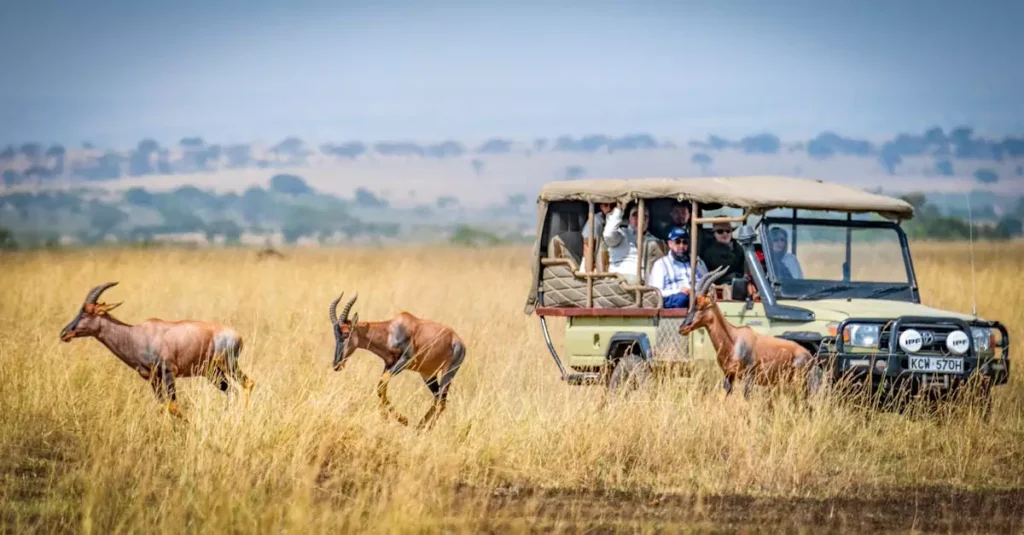
Safari jeeps — typically Land Cruisers or similar 4×4 vehicles — are purpose-built for this kind of travel. They have the ground clearance to handle the Mara’s unpaved tracks confidently, even when rain has turned red dirt roads into something resembling a mudslide. Most are fitted with pop-up roofs that allow passengers to stand safely and get unobstructed views and photographs. If you’re serious about wildlife photography, or you simply want the most immersive game drive experience possible, a jeep is the vehicle that makes that happen. There’s also something about the size and sturdiness of a Land Cruiser that just feels right when you’re a few meters from a pride of lions.
Tour vans — usually Toyota Hiace models or similar — are the more economical alternative. They handle paved roads well and many have been modified with pop-up roofs for game viewing. The trade-offs are real though: lower ground clearance means some areas become inaccessible after heavy rain, and a fully loaded van with passengers and luggage can feel cramped compared to a jeep. That said, for a lot of travelers, a tour van delivers a perfectly satisfying safari at a price that makes the whole trip more manageable. Most group tours use vans specifically to keep per-person costs reasonable.
The bottom line: if comfort, off-road capability, and top-quality viewing are priorities, a jeep is worth the premium. If your budget is tighter and you’re comfortable with some trade-offs, a tour van does the job. Before you book anything, always confirm in writing which vehicle type your operator will be using. This prevents unpleasant surprises once you’ve already arrived.
What Transport to the Masai Mara Actually Costs
Here’s where things get concrete. Prices vary based on vehicle type, whether you’re booking privately or joining a group, the season, and which operator you go with. But here are realistic ranges to work from:
Private safari jeep hire: $250 to $400 per day, typically including the vehicle, fuel, and a driver-guide. This gives you full flexibility — your own itinerary, your own pace, no compromising with other passengers on where to go or how long to stay watching a cheetah hunt.
Shared group tour van: $50 to $100 per person per day for transport, usually bundled into a larger package that covers accommodation and park entry fees. A standard 3-day, 2-night road safari in a shared van tends to run $400 to $800 per person all-in, depending on accommodation standard and what’s included.
Domestic flights (Nairobi to Masai Mara): $150 to $300 per person one-way, depending on the airline, how far ahead you book, and the time of year. Fly-in packages usually include a transfer from the airstrip to your lodge, but always confirm this because some operators charge for it separately.
These are ballpark figures, not fixed prices. Peak season — roughly July through October when the Great Migration is at its most dramatic — pushes prices up noticeably. Booking well in advance almost always gets you better rates than booking last minute.
One thing that catches a lot of people out: operators sometimes quote a headline price that looks attractively low, then add park entry fees, meals, or activity charges on top. Always ask for a full itemized breakdown of what’s included and what isn’t. Any reputable operator will give this to you without hesitation. If they’re evasive about it, that tells you something.
Comparing the Options Side by Side
| Shared Tour Van | Private Safari Jeep | Domestic Flight | |
|---|---|---|---|
| Cost (per person) | $50–$100/day (transport) | $250–$400/day (vehicle) | $150–$300 one-way |
| Travel time from Nairobi | 5–7 hours | 5–7 hours | 45–60 minutes |
| Off-road capability | Moderate | Excellent | N/A |
| Viewing quality | Good | Excellent | Aerial only |
| Baggage flexibility | High | High | Strict limits |
| Best for | Budget travelers, groups | Families, photographers, flexible itineraries | Short trips, luxury travelers |
| Main downside | Long bumpy journey, less rugged | Higher daily cost | Expensive, misses the overland experience |
A popular approach is to combine methods — fly in one direction and drive the other. You save time on the way in, maximize your days in the Mara, and still get the overland experience on the way back. It’s a genuinely good option if your budget allows for it.
The Honest Pros and Cons of Each Method
Tour van road travel is the most accessible entry point into the Masai Mara. You get to experience Kenya’s shifting landscapes, pass through small towns and rural communities, and stop at interesting points along the way. The journey itself can be part of the adventure if you approach it that way. The downside is time — 5 to 7 hours is a long stretch, especially on roads that can get rough, and it takes something out of you on arrival day. Viewing from a van is decent but doesn’t quite match what you get from a higher-clearance jeep.
Safari jeeps bring real advantages for game drives: superior terrain handling, elevated viewing angles, and pop-up roofs that put you at exactly the right height for watching and photographing wildlife. The journey from Nairobi is the same length as in a van, but it tends to feel more comfortable. The sticking point is cost — a private jeep hire is significantly more expensive, and that difference adds up over a multi-day safari.
Domestic flights solve the time problem completely. What would otherwise be a grueling 6-hour road journey becomes a 45-minute flight with panoramic views of the plains below. You arrive fresh and with more time for game drives. The aerial perspective — animals dotting the savannah, the Mara River snaking through the landscape — is genuinely breathtaking. The drawbacks are real though: this is the most expensive option by a significant margin, small aircraft impose strict baggage limits (usually around 15kg in a soft bag), and you miss the overland experience entirely. For travelers with limited time or those doing a luxury safari, flights make a lot of sense. For budget-conscious travelers, the math usually doesn’t work out.
Practical Tips for Managing Your Transport Budget
Book early. This is the single most effective thing you can do to control costs. Both domestic flights and safari packages tend to be cheaper when booked well in advance, and availability in peak season gets tight. Last-minute bookings during July–October can be dramatically more expensive.
Get quotes from multiple operators. Don’t settle for the first price you see. Request quotes from at least three reputable operators and compare them carefully — not just the total but what each one includes. The cheapest headline price isn’t always the best deal once you factor in what’s excluded.
Travel in a group whenever possible. Whether you’re splitting a private jeep with friends or joining a shared group tour, more people means lower cost per person. If you’re going solo, a group safari is almost always the most financially sensible option. If you have a group of four or more, a private jeep hire can actually become quite competitive per person.
Ask specifically about what’s included. Park entry fees, meals, airstrip transfers, activity fees — these can add up quickly if they’re not bundled into your package. The question “what’s NOT included in this price?” is often more useful than asking what is.
Think about the time-versus-money equation honestly. Road travel saves money but costs time. Flying saves time but costs money. If your schedule has flexibility, the road journey through rural Kenya has its own appeal and shouldn’t be dismissed as just a necessary inconvenience. If your trip is short or your schedule is tight, the flight may genuinely be worth the extra cost.
Pack light if you’re flying. Excess baggage fees on small domestic aircraft add up fast. Know the limits before you pack, and stick to them.
Frequently Asked Questions
What’s the cheapest way to get to the Masai Mara? A shared group tour van from Nairobi. Spreading the cost across multiple passengers makes this substantially cheaper than any other option.
How much does a private safari jeep cost per day? Between $250 and $400 daily, including the vehicle, driver-guide, and fuel. Prices vary with season and operator.
Are domestic flights worth the extra cost? If you have limited time, value comfort, and want to maximize game drive hours, yes. If budget is your primary concern, probably not — the road journey, while long, is manageable and has its own rewards.
How long is the drive from Nairobi to the Masai Mara? Budget 5 to 7 hours. Road conditions and stops can push this longer. Don’t plan anything time-sensitive on the day you arrive.
Is it better to book transport as part of a package or separately? For most travelers, a bundled package is simpler and often cheaper overall. Booking separately gives you more flexibility but requires more coordination. Experienced safari travelers sometimes prefer the latter; first-timers usually benefit from the former.
Final Thoughts
Transport isn’t just a logistics problem to solve on the way to the “real” safari. It shapes the whole experience — from how you feel when you arrive, to how much of the reserve you can actually access, to how many hours you spend watching wildlife versus sitting in transit.
The Masai Mara transport cost is one of the biggest variables in your overall budget, and understanding it properly puts you in a much stronger position when comparing options and making decisions. Whether you end up in a shared tour van, a private Land Cruiser, or stepping off a small bush plane onto a grass airstrip, what matters is that your choice reflects your actual situation — your budget, your time, and what you’re genuinely there for.
The Mara itself will deliver. Plan the journey there thoughtfully, and the whole trip comes together.
Planning your full safari budget? Our travel budget guide has a complete breakdown of costs beyond transport.